Milestones in ARUP Automation
For nearly three decades, ARUP Laboratories has invested in automation to improve efficiency, reduce errors, and shorten test turnaround times for patients and the clinicians caring for them. This ongoing commitment has helped support the organization’s growth and innovation—and continues to shape its future.
1998
Conveyance System
ARUP introduces its first conveyance system for preanalytic specimen handling and routing, which improves speed, reliability, and consistency and reduces delays and physical handling errors.
2003
Automated Storage and Retrieval System
ARUP implements a two-story, completely robotic Automated Storage and Retrieval System (ASRS). The ASRS freezer is a centralized, automated frozen specimen solution designed to support long-term specimen retention at scale while minimizing manual handling and preserving specimen integrity.
2008
Automated Sorters
Automated storage sorters begin handling postanalytic specimens to support freezer efficiency and reduce manual handling and search time.
2009
Custom Capper/Decapper
The first custom capper/decapper is developed in-house to support Reagent Lab Production. This achievement demonstrates ARUP’s ability to design and deploy custom-built automation when commercial solutions cannot meet throughput, container variability, or integration requirements specific to ARUP’s reagent operations.
2010
Sort-to-Light
Sort-to-Light (S2L) comes online. The S2L system is an internally developed, semiautomated specimen-sorting solution that uses illuminated bins to visually guide the routing of specimens to laboratory destinations. It was created to reduce specimen loss associated with manual sorting, particularly for nontrackable and critical-temperature specimens. Added benefits include faster routing, improved accuracy and traceability, reduced rework, and a reliable manual-automation bridge during track downtimes, helping ARUP to achieve near Six Sigma performance in specimen handling.
Automation Engineering
Automation Engineering is created as an offshoot of ARUP’s Bioengineering service group to enhance ARUP’s custom automation build efforts. This organizational milestone formalizes the creation of a dedicated team focused on the design, development, and build of custom automation systems, while Bioengineering remains focused on supporting, maintaining, and sustaining those systems once deployed.
2015
Linear Track System
The automation track system enables specimen-filled “pucks” to move at speeds of up to 2 meters per second on a track with no moving parts, which improves reliability and reduces required maintenance. The system integrates 10 high-speed sorters and six pick-and-place binders, all built in-house, to link physical specimen movement directly to the laboratory information system (LIS) for end-to-end traceability. A custom rack solution further standardizes routing across the specimen life cycle, improving throughput, accuracy, and scalability while reducing manual handling.
Sort-to-Light Doubles Capacity
The next generation of S2L doubles capacity, improves barcode reading, and reduces errors. This enhancement represents a significant evolution in ARUP’s original S2L concept, transforming it from a targeted error-reduction tool into a higher-throughput, more resilient core component of Automated Specimen Management.
2017
Six Sigma
ARUP achieves Six Sigma-level performance for lost specimens, led by Charles D. Hawker, PhD, MBA, scientific director of Automation, who created automation initiatives to improve specimen movement, tracking, and traceability.
Expanded Automated Storage
Automated storage sorters are expanded for accelerated specimen placement into the ASRS, reducing manual handling and enabling faster turnaround times for add-on and repeat testing. Faster, automated transfer to frozen storage minimizes delays, congestion, and temperature risk for specimens likely to be retrieved again.
Lab Automation Engineering Department
The Lab Automation Engineering Department is established to accelerate laboratory integrations and expand analytic-driven automation using liquid-handling technologies. A dedicated team of liquid-handling experts enables rapid, repeatable assay automation by combining deep assay knowledge with standardized automation practices, which reduces development time, improves consistency, and allows labs to adopt automation quickly and effectively at scale.
2018
Pipette-to-Light
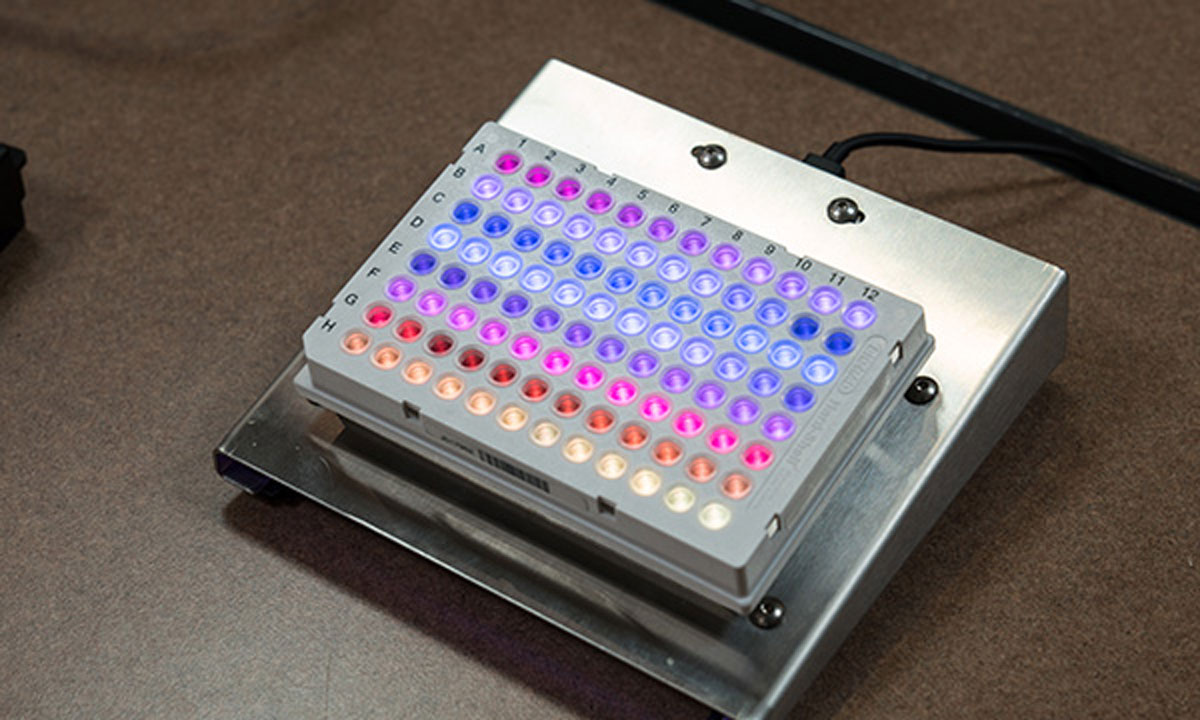
The Pipette-to-Light (P2L) solution supports medical technologists and reduces manual pipetting errors. This innovation introduces guided, visual cues directly at the point of manual liquid handling, helping technologists identify the correct wells, volumes, and sequence steps during complex pipetting tasks. Enhancing human work rather than replacing it, P2L improves accuracy in error-prone manual steps while preserving flexibility for assays not well suited to full automation.
Autonomous Mobile Robots
Autonomous mobile robots (AMRs) reduce manual specimen transport, minimize foot traffic between buildings, and create a flexible automation layer where fixed conveyance has been impractical. This effort enables ARUP to improve efficiency and safety while decoupling specimen movement from staff availability, laying the groundwork for scalable, resilient specimen handling as volumes and facility complexity increase.
The Automation Program
The Automation Program is established to centrally prioritize and manage enterprise automation demand, ensuring alignment, balanced resource allocation, and predictable delivery as automation is scaled across ARUP.
2019
Systems Engineering Department
The Systems Engineering Department is established to strengthen quality, reliability, and life-cycle governance across ARUP’s automation efforts. The group formalizes engineering standards and validation rigor, providing consistent approaches to system specification, installation/operational/performance qualification validation, documentation, and risk management to ensure safe, compliant, and reliable deployments.
2020
Automated Workflows During a Pandemic
During the COVID-19 pandemic, cross-functional teams rapidly deploy custom automation and liquid-handling solutions to scale testing capacity. The ability to quickly design and implement automated workflows is critical to reducing manual bottlenecks, maintaining quality, and delivering fast, reliable results during unprecedented testing demand, demonstrating automation as a core capability for surge response and resilience.
2021
System Integration
Building 4 opens with an expanded linear track system integrated with the Connex conveyance network, adding 1.4 miles of automated track capable of speeds of up to 90 feet per minute. This expansion enhances end-to-end specimen tracking, high-speed sorting, and floor-to-floor conveyance across the facility.
2022
Additional Autonomous Mobile Robots
More AMRs are deployed to further enhance specimen transport, establishing a shared, intelligent mobility platform rather than task-specific robots. Operating as a coordinated fleet allows AMRs to dynamically balance workloads, reroute based on demand or congestion, and scale seamlessly as volumes and use cases grow, which provides greater resilience, efficiency, and flexibility than if robots are constrained to single routes or fixed tasks.
2023
Targeted Automation
Cross-functional engineering teams collaborate to automate the high-volume QuantiFERON-TB Gold Plus assay, integrating labeling, capping, decapping, and liquid handling to support a fully automated workflow. Targeted automation addresses the assay’s single-tube workflow, strict handling requirements, and high daily volume, improving consistency and scalability while maintaining assay integrity and regulatory compliance.
2024
Liquid Handlers
The Lab Automation Engineering Department takes ownership of servicing all liquid handlers, delivering expert on-site support to reduce downtime and maintain the highest performance standards in production laboratories.
2025
Molecular Oncology Workflow
ARUP’s Lab Automation Engineering team develops a fully automated molecular oncology workflow encompassing DNA extraction, quantification, and polymerase chain reaction (PCR) setup. This initiative advances ARUP’s long-term vision of centralized DNA extraction and fully automated workflows to support the organization’s high-volume testing demands.
2026
Robotic-Assisted Processing
Early concepts for Robotic-Assisted Processing (RAP) of patient specimens are developed to reduce manual overhead and improve turnaround times. These initial efforts focus on rethinking how specimens move through preanalytic and analytic workflows, identifying repetitive, labor-intensive steps that could be standardized or automated. The goal is to shorten handoffs, reduce waiting and batching, and create more predictable, streamlined processing during the specimen processing steps.
Specimen Checkout Solution
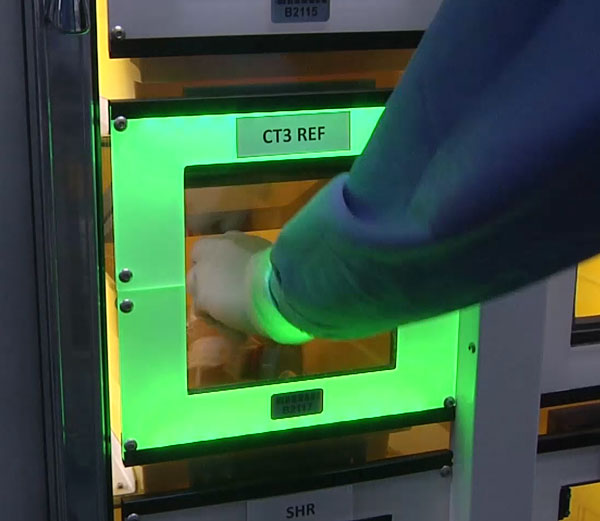
Conveyance systems within the ASRS are replaced with an updated specimen checkout solution, including retrofitted anteroom automation, to improve reliability and introduce operational redundancy for the ASRS. This evolution strengthens the downstream interface between automated frozen storage and laboratory users by modernizing checkout and conveyance workflows, reducing single points of failure, and improving recoverability during maintenance or unexpected downtimes.
Human-Centered Automation Systems: Built for Our People, Patients, and Clients
1998: ARUP introduces its first conveyance system for preanalytic specimen handling and routing, which improves speed, reliability, and consistency and reduces delays and physical handling errors.